Only one DEMO account followed it. The confidence written at entry was 5.0 out of 10.
It is the card STA users received, with the agents' reasoning and the levels decided before entering.
For days the price has been sitting on the same floor. It has touched it several times and always bounced, but the bounces are getting weaker and buyers are few. The floor looks tired rather than solid, so now we look for a fall, not a rise.
Nothing is opened for now. We wait for an hour of trading to close below 54.21, the sign that the floor has really given way and not just for a moment. If that doesn't happen, nothing is opened.
If instead the price goes back to 59.535, the idea is wrong, because the floor held and sellers never took control. At that point the position closes on its own, with a loss that is defined and known from the start.
The gain we're after is about as large as the risk taken, costs are low and it should play out within a couple of days. A level further down could slow the fall, and nothing is a given.
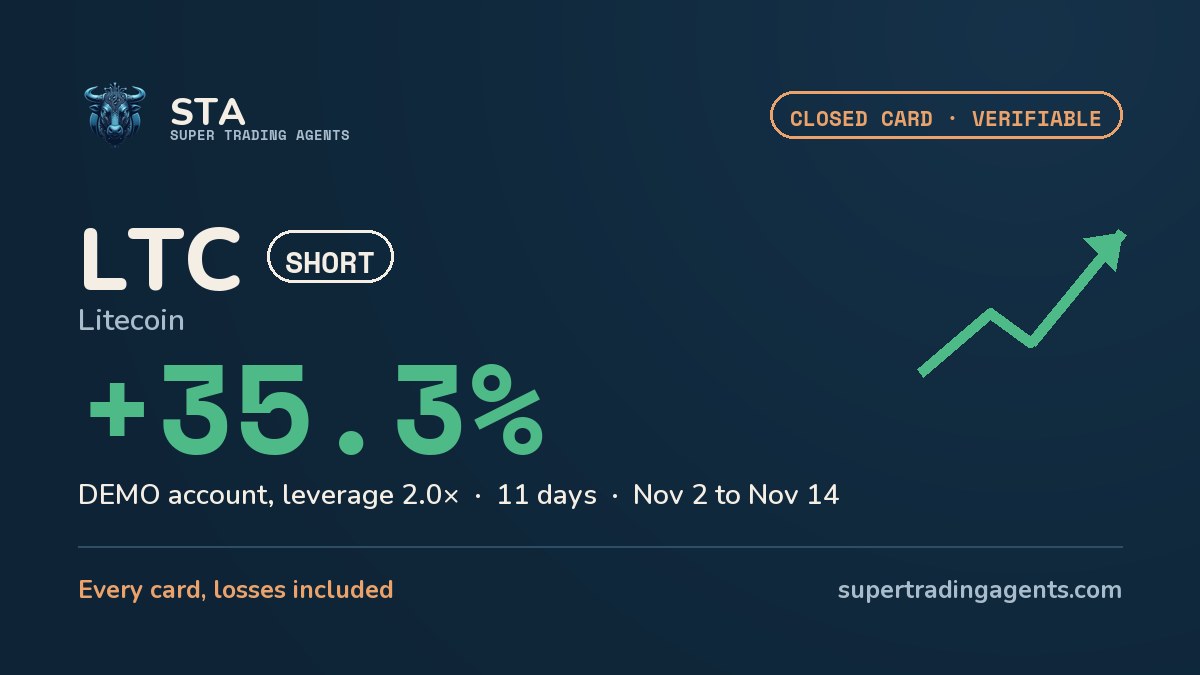
LTC is the coin of Litecoin, one of the oldest cryptocurrencies, born in 2011 as a lighter sibling of Bitcoin. In early November the price had been resting on the same floor for days. It had touched it several times and always bounced, but each bounce was weaker and buyers were showing up less and less.
The agents read that floor as tired, not solid. They set a Sentinel that would sell only after an hour closed below the level, so as not to mistake a simple touch for a real break. Confidence was 5 out of 10.
The Sentinel fired in a weak market, with almost every coin going down. The floor gave way and the price fell past the target, losing 17.6% in eleven days. The card was closed by hand near the low, with a result of 35.3% on the margin, and almost none of the move was given back. One DEMO account followed it.
The direction was right, the timing of the entry less so. When the Sentinel fired the coin had already lost 5% in a day, and on the hourly chart one signal still pointed up. The agents had also written down a specific risk, a squeeze phase that could break either way.
The result is good, but it doesn't prove that entering after a fall that has already run is a good idea. The lesson that goes into the agents' memory is that a late entry deserves more weight, even when it turns out well.
This card's hash was written in the public register on the day it was born, before anyone knew how it would end. Anyone can check that it has not been changed.
431bce1996f1… · the register of 02/11/2026
Understanding why a price moves shouldn't be a privilege for people who spend their days in front of charts. STA Super Trading Agents does that work for you. Ten agents study the market, argue among themselves and hand you a clear card, with the reason, the entry and the point beyond which the idea is wrong.
Then it's up to you to decide whether and how to use it. This page exists so that you can check how it really went.
This page tells the story of a closed card and is for information only. It is not investment advice and past results do not guarantee future ones. Trading crypto-assets involves a high level of risk, including the total loss of the capital invested.
